How Long Should Tier 2 Intervention Sessions Be?
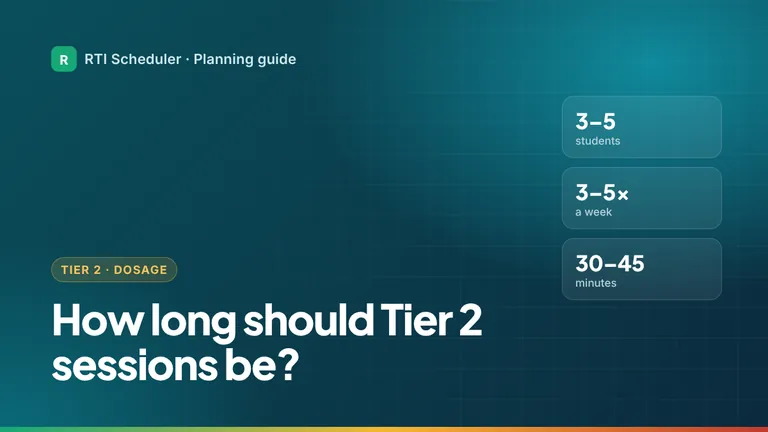
Tier 2 groups usually have 3 to 5 students and meet 3 to 5 times a week for 30 to 45 minutes over 10 to 12 weeks. How to turn that into a schedule.
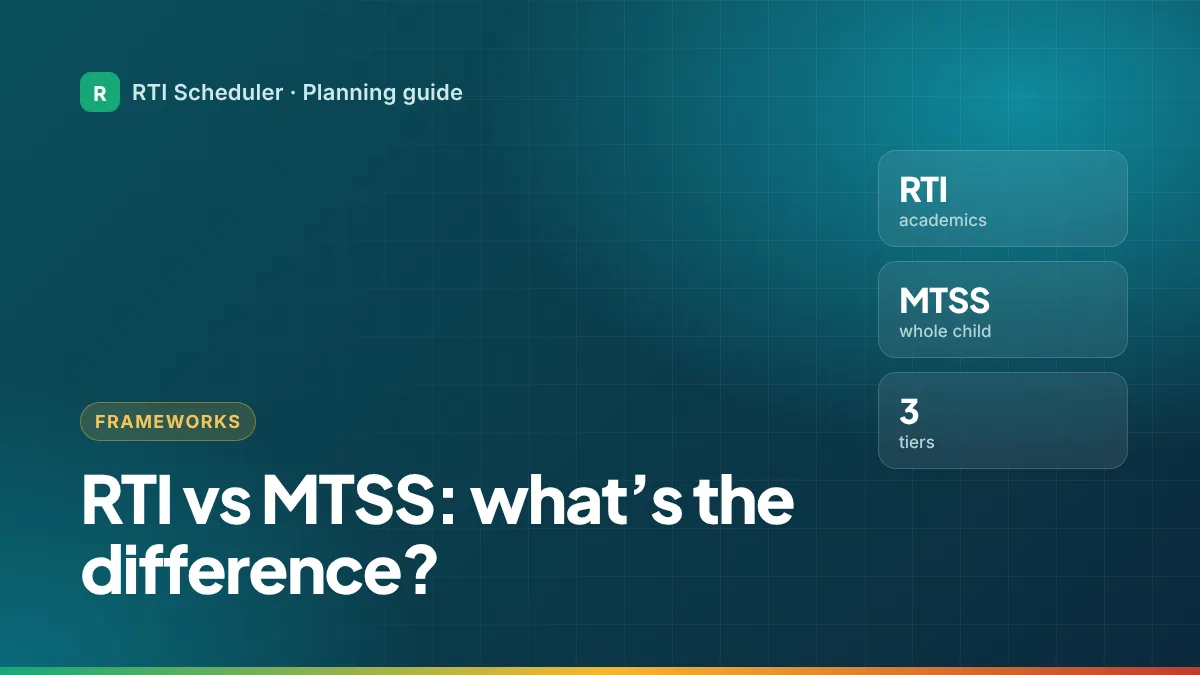
RTI and MTSS use the same three-tier idea, and many schools use the words almost interchangeably. The main difference is scope. RTI (Response to Intervention) is mainly about academic support. MTSS (Multi-Tiered System of Supports) is a wider, schoolwide framework that usually covers behavior and social-emotional needs too, plus the systems around them: staff training, teaming and how resources are used. In most schools today, RTI sits inside MTSS as its academic part.
| RTI | MTSS | |
|---|---|---|
| Main focus | Academic skills, mostly reading and math | Academics, behavior and social-emotional needs |
| Tiers | Three tiers of increasing support | Same three tiers |
| Data | Screening and progress monitoring | Same, plus behavior and attendance data in many schools |
| Scope | Instruction and intervention | Instruction plus schoolwide systems: teaming, training, leadership, climate |
| How they relate | Often the academic part of MTSS | The umbrella framework |
Both frameworks describe support in layers:
In MTSS, the same tiers apply to behavior. A schoolwide behavior expectation is Tier 1, a check-in/check-out routine might be Tier 2, and an individual behavior plan might be Tier 3.
For the person running the sessions, the change from RTI to MTSS often shows up on the calendar before anywhere else:
A practical tip: use a clear prefix for each kind of support in your planner, such as "T2 – Reading", "T2 – Behavior check-in" or "MTSS meeting – prep". You’ll see at a glance whether a week is balanced or overloaded. Our task naming guide has more patterns.
Both terms are still used. Many states and districts now describe their framework as MTSS, with RTI as the academic part. Some still call the whole thing RTI. Check what your district’s documents say and use the same words with your team.
Not quite. PBIS (Positive Behavioral Interventions and Supports) is a tiered framework for behavior. Under MTSS, it often works as the behavior side, alongside RTI on the academic side.
It usually means more coordination. The official records belong in your school’s approved system. Your own planner only needs to hold the times, the prep and the follow-ups, with no student names. See personal planner vs student records.
For the practical side of the tiers, read Tier 3 scheduling and how often to progress monitor.
Add the sessions and prep tasks from this guide to the free RTI Scheduler. No signup needed to start.
Start SchedulingTier 2 groups usually have 3 to 5 students and meet 3 to 5 times a week for 30 to 45 minutes over 10 to 12 weeks. How to turn that into a schedule.
Six ways schools make time for RTI and MTSS intervention: WIN blocks, staggered times, shorter periods, advisory time and hidden minutes, with real examples.
Convert RTI and MTSS team meeting decisions into dated, privacy-safe action tasks with owners, priorities and follow-up dates you will actually see.