How to Build an RTI Intervention Schedule (With Example)
Build a weekly RTI intervention schedule step by step: Tier 2 session lengths, WIN and flex blocks, prep, transitions and a sample week to copy.

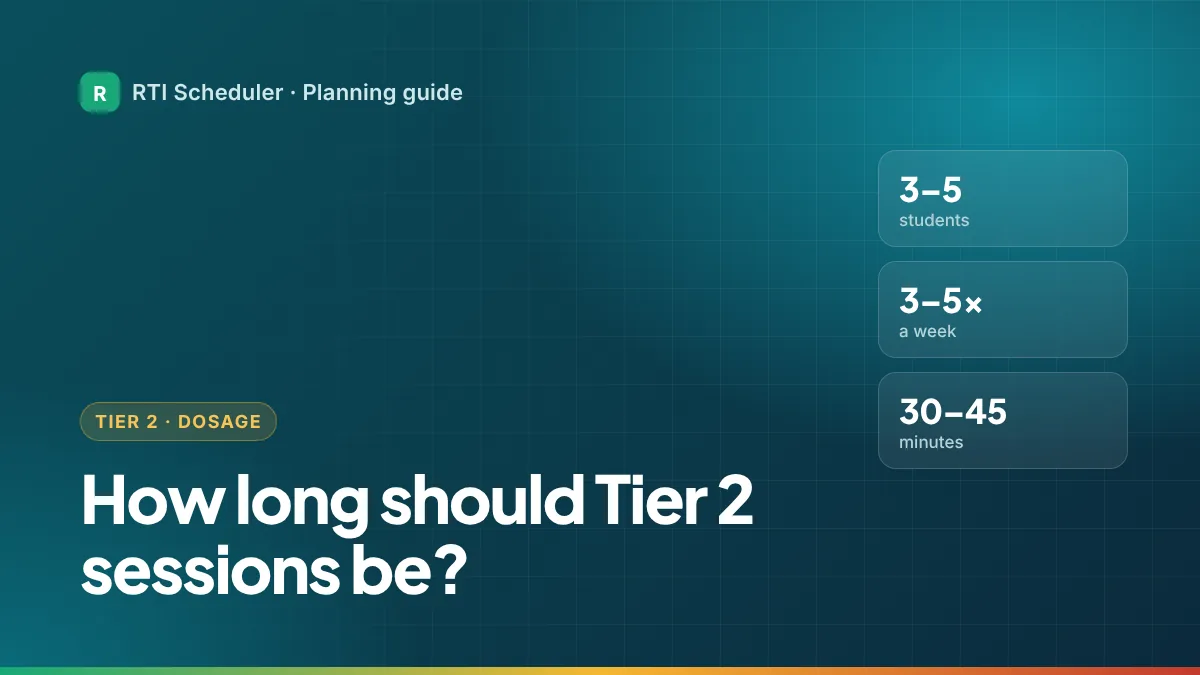
Most Tier 2 groups have three to five students and meet three to five times a week for at least 30 to 45 minutes, over a round of about 10 to 12 weeks. That’s how the IRIS Center at Vanderbilt describes effective Tier 2 instruction. Your school team sets the real numbers. This guide explains what each number means for your week, and how to turn a team’s decision into a schedule that actually holds.
These are typical research-based ranges, not rules. Your intervention program, the students’ needs and your team’s plan come first.
| Question | Typical Tier 2 answer |
|---|---|
| How many students per group? | 3 to 5 |
| How often does the group meet? | 3 to 5 times a week |
| How long is each session? | At least 30 to 45 minutes |
| How long does one round last? | A minimum of 10 to 12 weeks before judging progress |
Source: IRIS Center, Effective Instruction at Tier 2. Another IRIS module describes sessions ranging from 20 to 45 minutes (Tier 2), so shorter sessions do appear in practice, especially for younger students.
Teams often argue about 30 versus 40 minutes. In practice, the bigger risk is the minutes you lose without noticing. A "30-minute" group that starts five minutes late, spends four minutes settling and packs up three minutes early delivers about 18 minutes of teaching. Do that four days a week and the group quietly loses close to a full session every week.
So before you ask for a longer block, protect the one you have:
Guidance on scheduling intensive intervention, published by the Arizona Department of Education and based on the National Center on Intensive Intervention’s work, warns that brief sessions of about 15 to 20 minutes may be too short, and that three sessions a week instead of five may be too few for some students. That doesn’t mean every group needs 45 minutes daily. It means that when a student isn’t responding, dosage (how much time, how often) is one of the first things worth checking. See the Strategies for Scheduling guide (PDF).
Say your team agrees on a reading group that meets four days a week, 30 minutes each, for 10 weeks. That is 40 sessions. Here is how to put them on the calendar without losing track:
Your official record of what was delivered belongs in your school’s approved system. In your own planner, a simple habit helps: mark each session done as it happens. At the end of the week, any session that isn’t marked done is one that needs moving or a note to your team. Over a 10-week round, that’s how you notice early that a group is getting half the time it was promised.
Moving a student up to more intensive support? See how often and how long Tier 3 runs, and how often to progress monitor.
Add the sessions and prep tasks from this guide to the free RTI Scheduler. No signup needed to start.
Start SchedulingBuild a weekly RTI intervention schedule step by step: Tier 2 session lengths, WIN and flex blocks, prep, transitions and a sample week to copy.
Three elementary RTI schedule examples: a staggered WIN block by grade, a small-group rotation in the literacy block, and one interventionist’s full day.
Plan a 30-minute intervention block with setup, instruction, wrap-up and transition time built in, so each session starts on time and ends calmly.