Elementary RTI Schedule Examples: WIN Blocks, Rotations and a Specialist’s Day
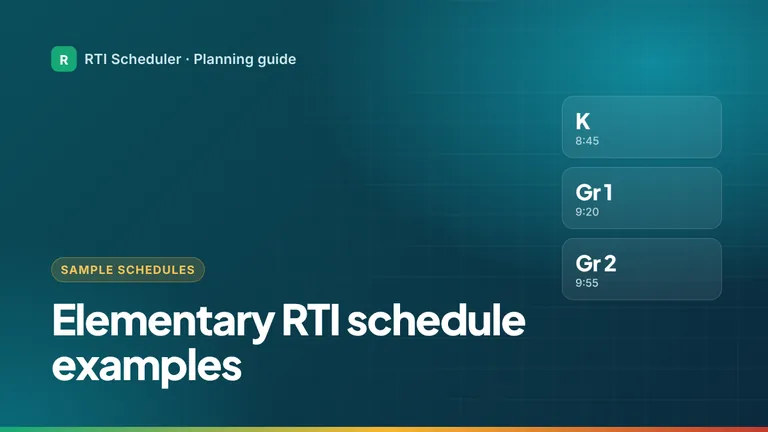
Three elementary RTI schedule examples: a staggered WIN block by grade, a small-group rotation in the literacy block, and one interventionist’s full day.
WIN time (short for “What I Need”) is a protected block in the school day when every student gets the support they need next: extra teaching for students who are behind, practice for students who are almost there, and enrichment for students who are ready to move on. It usually runs every day, often for about 30 minutes, and groups change as students’ needs change. Done well, it gives schools a place for Tier 2 intervention that doesn’t take students out of core lessons.
| Question | Typical answer |
|---|---|
| What does WIN stand for? | What I Need |
| How often? | Daily in most schools |
| How long? | Often 30 minutes, sometimes up to an hour |
| Who takes part? | Every student, not only those who need intervention |
| How are groups made? | From assessment data and teacher observation, by skill |
| How often do groups change? | Regularly; some schools review weekly |
Length, frequency and grouping figures from NWEA’s guide to how WIN time supports intervention (2026).
Most schools have the same problem: students who need extra help can only get it by missing something else. Pull them out of science and they fall behind in science. Pull them out of core reading and they get less of the very subject they’re struggling with.
A WIN block solves that by making intervention part of the timetable for everyone. Because the whole grade (or school) is in WIN at the same time, nobody misses a core lesson, and students who need support aren’t singled out. Everyone goes somewhere.
It also makes staffing easier. Specialists, classroom teachers and support staff can all be assigned to the same block, so intervention groups stay small. The Center on MTSS recommends exactly this: a common intervention and enrichment block, with staff assigned so intervention groups are small and enrichment groups larger (schedule tip sheet, PDF).
| Students who… | Usually get | Group size |
|---|---|---|
| Need targeted support (Tier 2) | Small-group intervention on a specific skill | Small, often 3 to 5 |
| Need intensive support (Tier 3) | Individualized intervention, sometimes on top of WIN | Very small |
| Are nearly there | Guided practice and review | Medium |
| Are on track or ahead | Enrichment, projects, extension work | Larger |
For Tier 2 group sizes and session lengths, see how long Tier 2 sessions should be.
| Problem | What’s usually going on | Fix |
|---|---|---|
| Groups never change | No regular review | Put a regrouping date on the calendar |
| WIN feels like study hall | Unstructured digital or independent time | Give every group a clear goal and an adult |
| Intervention groups are too big | Not enough staff in the block | Stagger grades, or add support staff |
| Students see WIN as a label | Only struggling students move | Everyone moves to a group, every day |
| WIN keeps getting cancelled | Seen as optional | Schedule events outside the block |
If you teach a WIN group, your planning job is small but important: know which group you have each day, have materials ready before the bell, and note anything to bring to the next regrouping meeting. A simple routine:
No. RTI (and MTSS) is the overall framework of tiered support. WIN is one way to schedule time for it. Read RTI vs MTSS for the framework side.
It shouldn’t. WIN is extra time on top of core instruction. If WIN replaces a core lesson for some students, they get less core teaching, which is the opposite of the goal.
Yes, usually as a flex or advisory period. See intervention periods in middle and high school.
They’re closely related. “Flex” usually describes a secondary period where students may choose some activities, while WIN usually means placements decided by data. Many schools mix both.
Add the sessions and prep tasks from this guide to the free RTI Scheduler. No signup needed to start.
Start SchedulingThree elementary RTI schedule examples: a staggered WIN block by grade, a small-group rotation in the literacy block, and one interventionist’s full day.
Six ways schools make time for RTI and MTSS intervention: WIN blocks, staggered times, shorter periods, advisory time and hidden minutes, with real examples.
How middle and high schools create a flex or WIN intervention period, what makes it work, common problems, and how a teacher can plan their part each week.