How to Find Time for Intervention in the School Day
Six ways schools make time for RTI and MTSS intervention: WIN blocks, staggered times, shorter periods, advisory time and hidden minutes, with real examples.

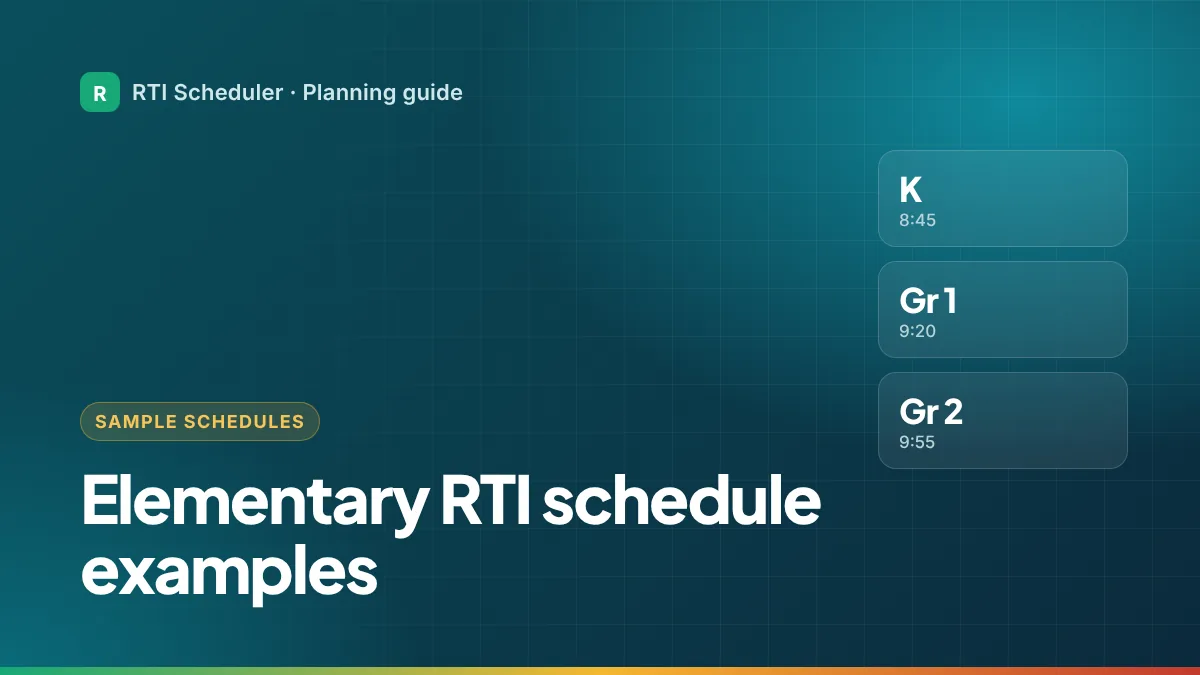
Seeing a real-looking schedule makes RTI planning much easier than reading about it. Below are three common ways elementary schools fit intervention into the day: a staggered WIN block, an in-class small-group rotation, and a specialist’s day across several grades. All times are examples. Your school’s bell schedule and your team’s plan decide the real ones.
In this model, each grade has a 30-minute "What I Need" (WIN) block at a different time. During the block, every student gets either intervention or enrichment, so nobody misses core teaching. Because the blocks are staggered, one reading specialist and one math interventionist can support every grade.
| Grade | WIN block | Reading specialist | Math interventionist |
|---|---|---|---|
| Kindergarten | 8:45 – 9:15 AM | T2 phonics group | — |
| Grade 1 | 9:20 – 9:50 AM | T2 phonics group | T2 number sense group |
| Grade 2 | 9:55 – 10:25 AM | T3 decoding session | T2 math facts group |
| Grade 3 | 12:50 – 1:20 PM | T2 fluency group | T2 math facts group |
| Grade 4 | 1:25 – 1:55 PM | T2 fluency group | T3 fractions session |
| Grade 5 | 2:00 – 2:30 PM | T2 comprehension group | T2 fractions group |
Notice the five-minute gaps. They’re not wasted. They’re the time it takes to walk to the next room and collect the next group. Schools often put younger grades in the morning, but that’s a local choice.
Some schools don’t run a separate block. Instead, the classroom teacher runs small groups during a 90-minute literacy block, and Tier 2 happens in one of the rotations. Here’s how one teacher’s block might look:
| Time | Whole class | Teacher table |
|---|---|---|
| 9:00 – 9:30 AM | Core reading lesson (Tier 1) | Leads the whole class |
| 9:30 – 9:50 AM | Independent practice and centers | Small group A (on grade level) |
| 9:50 – 10:10 AM | Independent practice and centers | T2 group B (extra support) |
| 10:10 – 10:30 AM | Independent reading | Small group C (extension) |
The catch: Tier 2 here is in addition to the core lesson, not instead of it, so group B still gets the full 9:00 lesson. If group B also needs a second dose, that usually goes into a WIN block or another slot later in the day.
This is the view that matters most to a specialist: your own day, with prep and travel built in. Group names are kept general so no student is identifiable.
| Time | Task | Priority |
|---|---|---|
| 7:50 AM | Prep – set out phonics cards for K and Grade 1 groups | High |
| 8:45 AM | T2 – Phonics group K-A (Room 3) | High |
| 9:20 AM | T2 – Phonics group 1-A (Room 7) | High |
| 9:55 AM | T3 – Decoding session 2-B (Library table) | High |
| 10:30 AM | Follow-up – log morning sessions in school system | Medium |
| 11:15 AM | Prep – copy fluency passages for afternoon groups | High |
| 12:50 PM | T2 – Fluency group 3-A (Room 14) | High |
| 1:25 PM | T2 – Fluency group 4-A (Room 16) | High |
| 2:00 PM | T2 – Comprehension group 5-A (Room 18) | High |
| 3:15 PM | MTSS team meeting – bring group notes | Medium |
In RTI Scheduler you’d add the 8:45 group once and choose Repeat, then do the same for each group. When an assembly moves one Tuesday, you change that single session and leave the rest alone.
The Arizona Department of Education’s Strategies for Scheduling guide (PDF) describes elementary schools in Tacoma that ran a 30-minute, and in one case a 30- to 40-minute, intervention block per grade. That’s the same idea as Example 1. For group sizes and session lengths, see how long Tier 2 sessions should be.
Whichever you choose, the routine that keeps it working is the same: fixed times, prep scheduled the day before, and a short weekly review. For the building-level decisions behind this, read how to find time for intervention in the school day.
New to the idea of a shared intervention block? Start with what WIN time is and how it works.
Add the sessions and prep tasks from this guide to the free RTI Scheduler. No signup needed to start.
Start SchedulingSix ways schools make time for RTI and MTSS intervention: WIN blocks, staggered times, shorter periods, advisory time and hidden minutes, with real examples.
Compare push-in and pull-out intervention, then build an interventionist’s daily schedule around core times, travel buffers and prep, with a sample day.
Tier 2 groups usually have 3 to 5 students and meet 3 to 5 times a week for 30 to 45 minutes over 10 to 12 weeks. How to turn that into a schedule.